October 27, 2025
Abeer Almadawy and the Principles of the Egyptian Dream
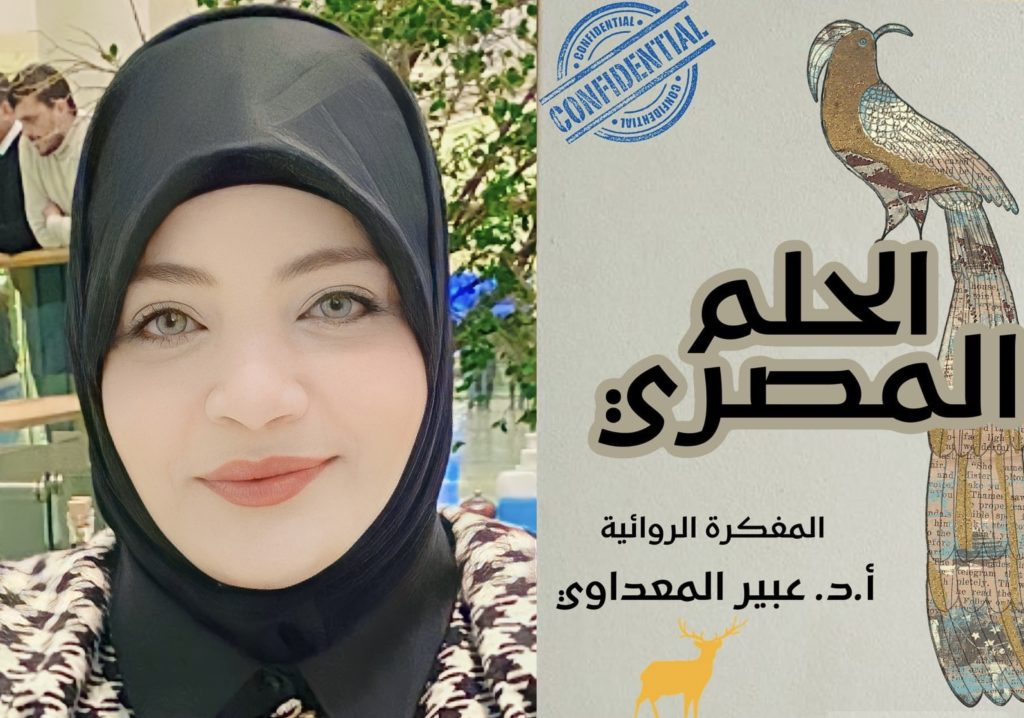
Abeer Almadawy , the Egyptian thinker and novelist has written a book with the title ( The Egyptian Dream ) .
Almadawy wrote in it;
One of the essential pillars of the Egyptian Dream I present is the state’s responsibility to nurture culture as an educational foundation, shaping the national character and reviving the authentic Egyptian identity.
Abeer Almadawy continued that ;
Culture is not a luxury of thought; it is a fundamental right for every citizen and a true weapon against ignorance, corruption, and regression — a shield that protects minds from all forms of intellectual occupation and colonization, which are no longer symbolic concepts but a scientific reality confirmed by modern studies.
Positive culture is what every human being needs today to reconstruct their personality, regain emotional and social balance, and free themselves from the unhealthy fanaticism that distorts their behavior and perception of life.
It is through culture that one learns to interact with life rationally, to distinguish between authenticity and imitation, between genuine progress and hollow appearances.
Culture, therefore, is not merely knowledge; it is a moral and behavioral force that guards individuals against the manipulations of political, religious, or social ideologies that seek to dominate their consciousness.
Here Abeer Almadawy point of view that The dream is not an illusion, nor a collection of idealistic notions. It is a realistic vision built upon clear principles, affirming that national revival begins with the individual.
The decline of culture has long been the real cause behind the suffering of citizens — from extremism and corruption to injustice and the alarming moral and behavioral patterns that now require firm confrontation.
Thus, the revival of culture, reading, and collective awarenessmust be the first step toward rebuilding a mature and enlightened society.
Within the framework of research in political and social communication, conducted under The Egyptian Campaign for Cognitive Development and Political-Social Media, licensed by the Ministry of Justice, it was observed that the youth’s withdrawal from education and the decline in labor competence stem not only from the weaknesses of the educational system but also from the erosion of culture itself and the absence of inspiring intellectual models.
The campaign also revealed a dangerous spread of negative cultural patterns, such as addiction, drug abuse, and foreign habits alien to Egyptian society.
Worse still, thuggery (balṭaga) has been glorified into a false social model, idolized in poor neighborhoods where some young people, deprived of education and cultural grounding, began to see such figures as role models.
In this way, genuine moral values were displaced and replaced by degradation — a tragic consequence of the cultural vacuum that has weakened the collective conscience.
Reviving culture is the first step toward restoring the Egyptian human being — toward rebuilding a future worthy of Egypt’s history and its eternal civilizational identity.