June 25, 2026
Nuances That Distinguish the Third Mind for Abeer Almadawy from Previous Theories
Nuances That Distinguish the Third Mind for Abeer Almadawy from Previous Theories
Philosopher Abeer Almadawy
Expanded Historical and Philosophical Context
Throughout history, humanity has sought to understand mind, spirit, and consciousness, with distinct contributions in each era:
1. Greek Philosophers:
• Plato: Focused on the soul and spirit, believing true knowledge comes from contemplating the ideal world, but he did not directly link mind with cosmic consciousness or the memory of the spirit as we do today.
• Aristotle: Studied the mind as a tool for analysis and logical thinking, focusing on the conscious and practical, without integrating spiritual or unconscious dimensions fully.
2. Eastern Mystics and Philosophers:
Focused on meditation and spiritual connection, such as Avicenna and Al-Ghazali, treating the spirit as a path to divine knowledge. However, their practices were often symbolic or mystical, lacking a scientific method combining conscious, subconscious, and spiritual minds.
3. Modern Psychologists:
• Freud: Studied conscious and unconscious minds, viewing the subconscious as a repository for repressed desires and memories, but did not address the spirit or connection to cosmic consciousness.
• Jung: Introduced a spiritual dimension through the collective unconscious and symbols but did not provide a practical mechanism to connect this knowledge with individual conscious awareness or daily life.
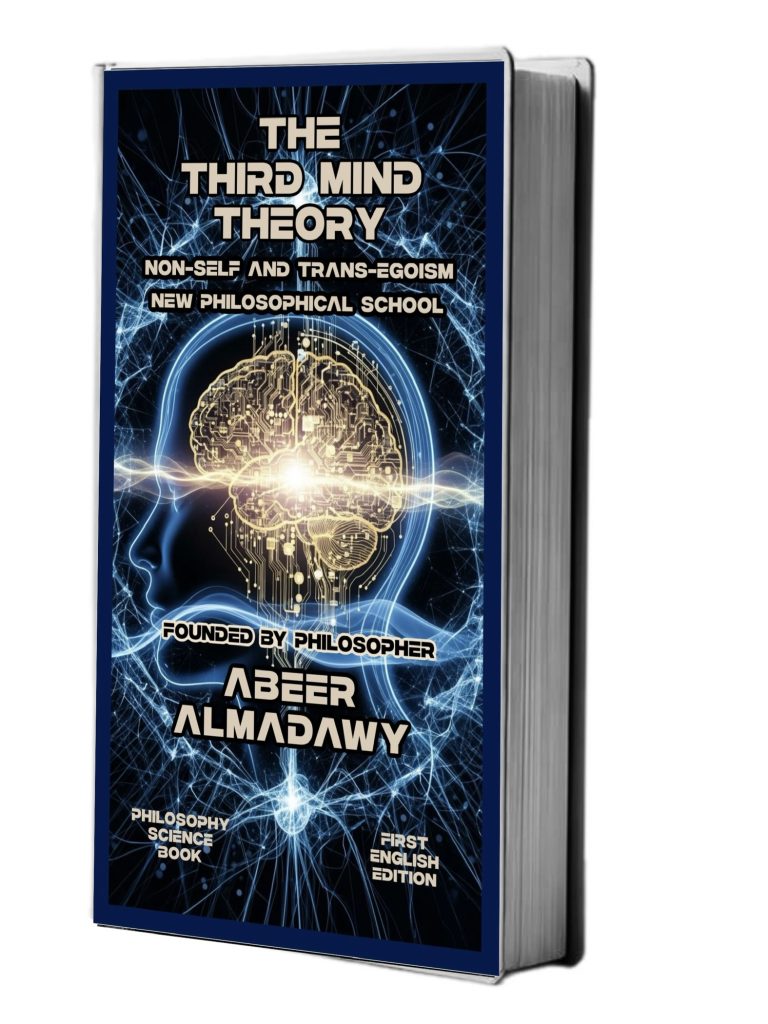
• The Third Mind is not limited to psychological analysis or symbolic contemplation; it embodies the memory of the spirit and the human’s direct relationship with cosmic consciousness. It also unifies the first mind’s memory with the spirit’s memory.
• It is a practical tool, enabling interpretation of symbols, understanding daily signals, hidden knowledge, creativity, and spiritual growth—not just theoretical analysis or reflection.
• It integrates conscious and subconscious minds with the memory of the spirit, forming a unified cognitive system that allows humans to develop themselves scientifically and philosophically—a contribution no previous thinker has made in this way.
• It is linked with the philosophy of the Non-Self and the Transcendent Ego, enabling liberation from the superficial self, overcoming psychological and material constraints, and achieving comprehensive, sustainable awareness.